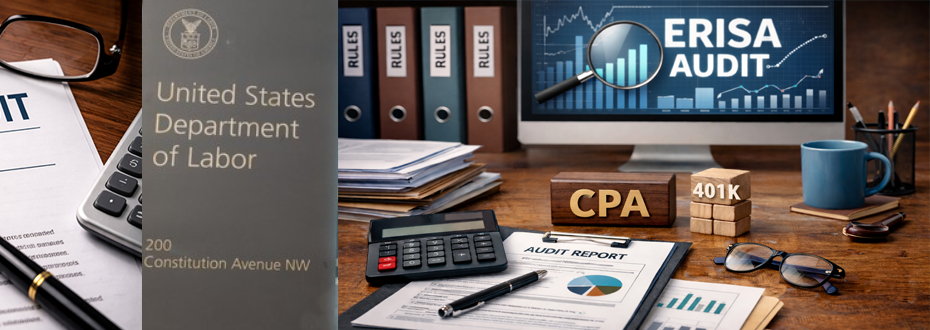
Employee benefit plan compliance isn’t just a regulatory obligation; it’s a fiduciary responsibility. For businesses offering retirement plans, understanding ERISA audit requirements and 401(k) audit rules is essential to protecting both the organization and its employees. An ERISA audit provides independent verification that a plan is being operated correctly, contributions are handled properly, and federal filing obligations are met.
Rojas & Associates
1-800-969-7433
Certified Public Accountant Sacramento
What Is an ERISA 401k Audit?
An ERISA audit is an independent evaluation of a company’s employee benefit plan—most commonly a 401(k)—to confirm compliance with ERISA and DOL rules. At Rojas & Associates, CPAs, we perform these audits for plan sponsors of all sizes and industries, helping them navigate the complexities of retirement plan compliance.

A 401(k)/ERISA audit typically focuses on three core objectives:
- Confirm compliancewith ERISA and DOL regulations
- Ensure accuracyof the plan’s financial statements
- Identify operational issues that may indicate non-compliance or fiduciary risk
At Rojas & Associates, CPAs, we help companies navigate the complexities of 401(k) audits with clarity and confidence. As a trusted CPA firm in Sacramento, we work with plan sponsors across industries to ensure their retirement plans remain compliant, efficient, and ready for Form 5500 filing deadlines without unnecessary disruption to daily operations.
Who Must Have a 401(k) / ERISA Audit?
Not all retirement plans require an audit. The DOL’s requirements are primarily based on plan size and participant count.
Your plan typically requires an audit if:
- Your plan has 100 or more participants with account balances
Plans with 100+ eligible participants at the start of the plan year must include an independent audit with their Form 5500 filing.
- Your plan files an annual Form 5500
All qualified retirement plans must file Form 5500 annually, but only “large” plans (generally 100+ participants) must attach an audit report.
- Your plan transitions to ‘large plan’ status
If your plan crosses the 100-participant threshold at the beginning of a plan year, an audit becomes required for that year.
- The 80–120 Participant Rule Applies
If your plan has between 80 and 120 participants, you may (in many cases) file using the prior year’s status. This rule can prevent unnecessary switching between “small plan” and “large plan” filing requirements.
What Happens During a 401(k) / ERISA Audit?
At Rojas & Associates, CPAs, our audit approach is structured to be efficient, transparent, and educational for plan sponsors. Most audits follow these steps:
- Planning Meeting
We meet with your management team and plan administrator to outline the audit scope, timeline, and deliverables.
- Document & Data Collection
We request key plan documents, including the plan document and amendments, trust statements, payroll files, contribution reports, loan activity, and other supporting records.
- Operational Review
Our auditors assess how the plan is administered on a day-to-day basis. This includes payroll processes, contribution remittance, eligibility determinations, and participant communications.
- Transaction Testing
We select a sample of participant transactions—such as contributions, distributions, loans, and enrollments—and verify accuracy and compliance with plan rules.
- Internal Control Assessment
We evaluate the controls surrounding payroll processing, plan oversight, and financial reporting to determine whether the plan is being managed effectively.
- Compliance Review
We confirm that the plan follows ERISA regulations, DOL requirements, and all deadlines related to contributions, notices, reporting, and disclosure.
Benefits of a 401(k) Audit
A well-performed audit does more than satisfy a compliance requirement. Additional advantages include:
Compliance Confidence
ERISA audits help safeguard your plan from DOL penalties by identifying operational issues early. Firms with deep ERISA experience—like Rojas & Associates, CPAs—are more likely to perform thorough, high-quality audits.
Operational Improvements
Audits often uncover opportunities to streamline contributions, participant enrollments, and administrative processes—saving staff time and reducing errors.
Stronger Fiduciary Oversight
An audit reinforces your commitment to protecting employees’ retirement assets, building trust with your workforce.
Risk Reduction
We identify potential fiduciary risks, prohibited transactions, untimely remittances, or documentation gaps so they can be corrected before becoming compliance issues.
Strategic Insights
Our audit findings may highlight ways to refine plan design, enhance employee engagement, or strengthen internal controls.
How Rojas & Associates, CPAs Can Help
At Rojas & Associates, CPAs, we understand that ERISA compliance is complex and constantly evolving. Our team provides:
- Specialized ERISA training and experience
- Efficient audit processes designed to minimize disruption
- Clear communication and practical recommendations
- Audit services for 401(k), 403(b), profit-sharing, defined benefit, health & welfare, and other employee benefit plans
As a firm led by Bob Rojas, CPA, CExP, MT, we take pride in delivering personalized, high-quality service tailored to each plan sponsor’s needs. Our goal is to make your audit process smooth, informative, and beneficial to your organization.
Ready to Prepare for Your 401(k) Audit?
If your plan is approaching audit season—or you’re unsure whether an audit is required—our team can guide you through every step.
Contact Rojas & Associates, CPAs, today to speak with Bob Rojas or a member of our audit team.
Working with a qualified CPA firm for the annual 401(k) audit is important to staying
proactive. This not only reduces the likelihood of a DOL Audit investigation but also strengthens fiduciary oversight and protects participants.
This article is related to:
401k plan audit
What Is an ERISA 401k Audit
DOL audit
401k audit firms
Related Article:
What Triggers a Department of Labor 401k Audit
How to Prepare for Your 401k Audit